Your Vision Matters
Innovating for Outcomes with AI: Your Vision Matters
The biggest improvements in our current era will come from bold visions enabled by AI. The technology is the major revolution that brings us out of the information age, into the knowledge age.
If you are thinking that AI will help you do faster what’s already been done, you’re right, and you’ll miss the boat. This post hopes to inspire you to innovation that improves the world, your organization, and yourself.
The post will cover characteristics of an organization and its solutions that will make the biggest advances, as described by Judson Althoff, CEO Microsoft commercial business, in a 2025 blog post and later at Microsoft’s 2025 Ignite conference. The author ends with opinions and links to the keynote speech and blog post that were the inspiration.
Frontier Success Framework
Attribution: The author gleaned this framework from Judson’s 2025 Microsoft Ignite keynote speech, and recommends the reader should watch this along with the practical implementations offered in subsequent sections of the keynote.
Judson wrote and spoke about the concept of “Frontier”. It is an apt adjective to frame the conversation: are we going to the undiscovered or not? Organizations can be Frontier Organizations or just organizations. Aspirations can be Frontier Goals or just goals. He distinguished that Frontier Transformation is distinctly different than AI Transformation; human vision with technical skills is required to make the leap. Frontier is about the goal where one can “empower human ambition and find AI-first differentiation”.
Success will come for those who understand how AI will help.
- Real-time engagement with customers
- Better relationships with customers for better results with a better cost structure
- Re-shape business processes
- Focus on innovation
He spelled out 3 traits of Frontier Transformation. These should be true to attain those goals.
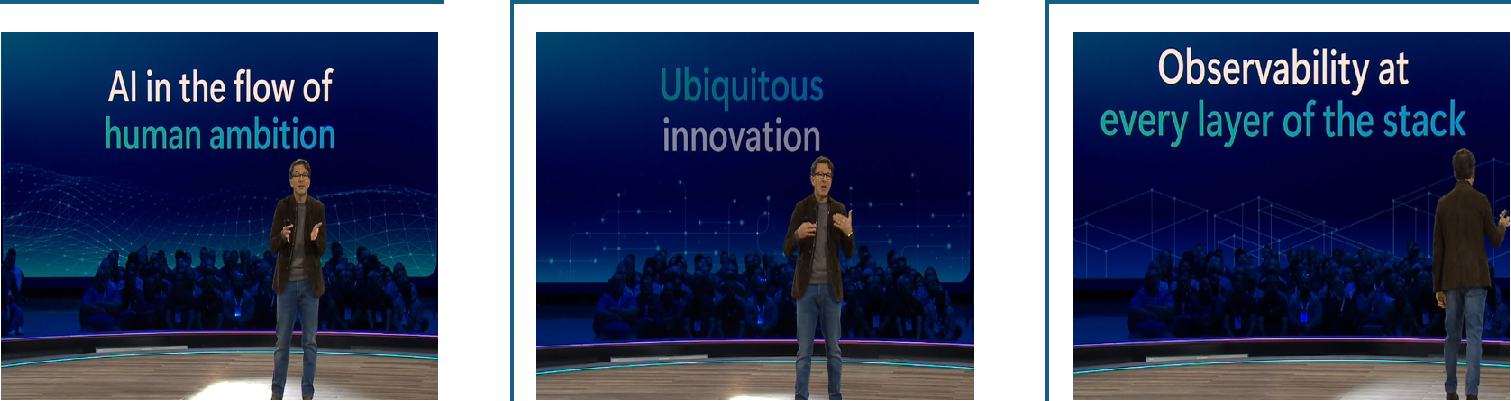
- Put AI in the Flow of Human Ambition: Make AI seamlessly accessible to get real work done. Democratize intelligence!
- Ubiquitous Innovation: There’s a maker in every one of us, so put tools in the hands of the people closest to the problem who are the best to solve it. Obsolesce the mundane!
- Govern and manage the AI: Utilize observability at every layer of the stack. Know how many agents you have, how many people access them daily, and what the results are.
He defined the fundamental building blocks of Frontier.
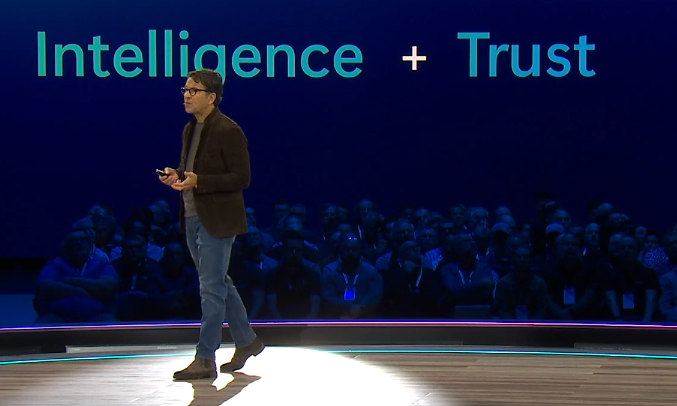
- Intelligence - put the “i” back into “AI”. AI needs to know how you work, with whom you work, and the concepts over which you reason.
- Trust - aligning AI to get the outcomes you want to achieve, your IQ, your differentiation.
This is the mindset shift from technology-focused to business-led transformation empowered by AI. It won’t happen with just the technical skills to deliver AI solutions.
Why He is Right: a Logic Argument and Unique Human Abilities
These are the driving forces behind the approach, so writing about them and reading about them will make us collectively smarter. The choices are to embrace this as is, refine it, replace it, or ignore it. We can only choose which with critical thinking. For the author, this is why Judson’s framework is compelling and is a great starting point.
The greatest innovations haven’t been made yet. This can mean small scale that makes your meal healthier or large scale that makes hunger go away. So, follow this logic that starts circling the way to get AI to get to the next greatest innovation.
- Data collection has grown in every field for the past 50 years or more
- AI utilizes existing data, which includes discovered facts and also written and transcribed spoken ideas
- Users of AI can choose to improve current tasks to achieve a known outcome
- Existing tasks can be simplified by leveraging optimal paths to those known outcomes
- Users of AI can alternately choose to converse with AI as an innovation partner, feed it with evolving ideas that grew from the user’s vision, and uncover new outcomes
- AI can then reach new conclusions, and users can introduce vision that only exists in the mind
- New conclusions will lead to new approaches and more new ideas
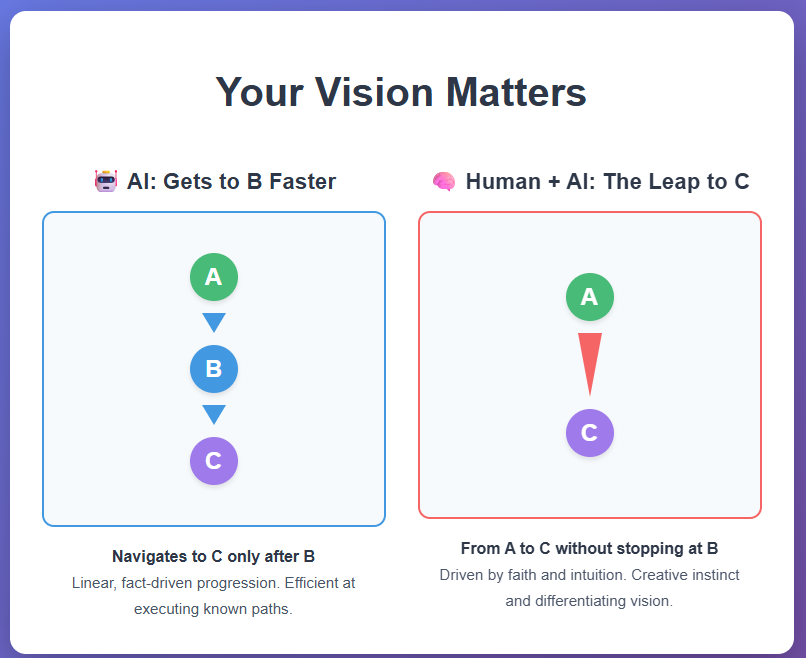
Human brains are the ultimate champions of “connecting the dots”. This is where your differentiating vision is the key to the next big thing. We humans can skip steps sometimes based on intuition. As we commonly say about an innovation, it went from a to c without stopping at b: a non-linear leap that lacks facts but is driven by faith and intuition. AI implicitly works by navigating to c only after b. We want it involved because it can often get to b faster than a human. It still needs a human manager for the creative instinct, the vision!
The opportunity cost of revising, refactoring, or tweaking some procedure that already exists is the avoidance of new conclusions and new ideas that would otherwise spring forth. Without vision, it will take time and others’ experience to get to c.
Conclusion
There are important concepts framed nicely by Judson in his speech and writing. This summary is important to the author as it introduces a new vocabulary for this new era. Many will invest their fortunes into AI, and the author hopes this brings humanity to its next higher level of existence.